
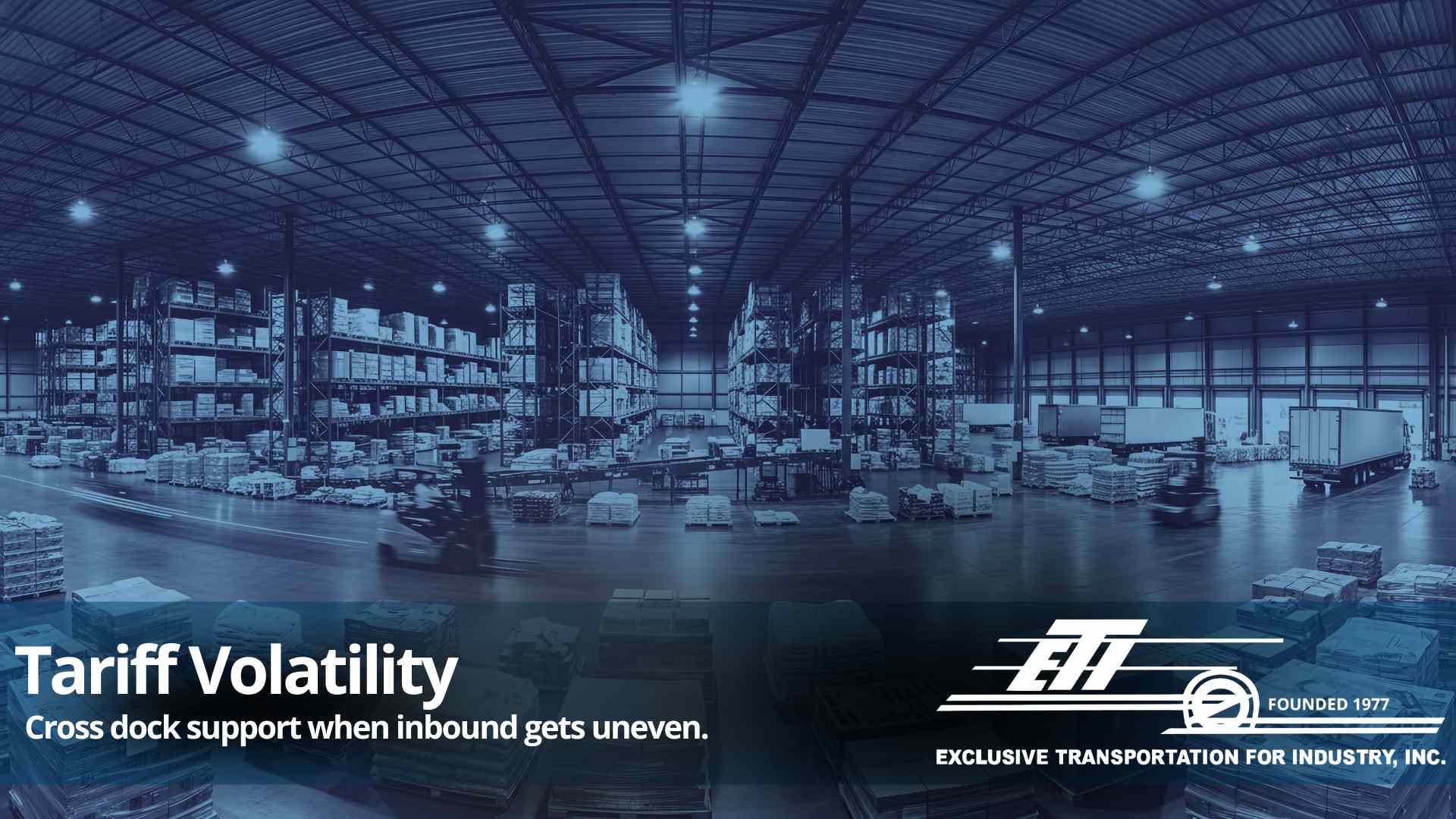
Tariff volatility has a way of showing up in places most manufacturers do not expect. Not in a spreadsheet. Not in a headline. It shows up at the dock door.
One week inbound freight is steady and predictable. The next week you are staring at a spike driven by pull forward buying, supplier changes, and shifting lanes. Trucks arrive early, late, or all at once. Appointment windows tighten. Floor space disappears. Production teams ask the same urgent question: how do we keep the line moving when the shipping rhythm changes overnight?
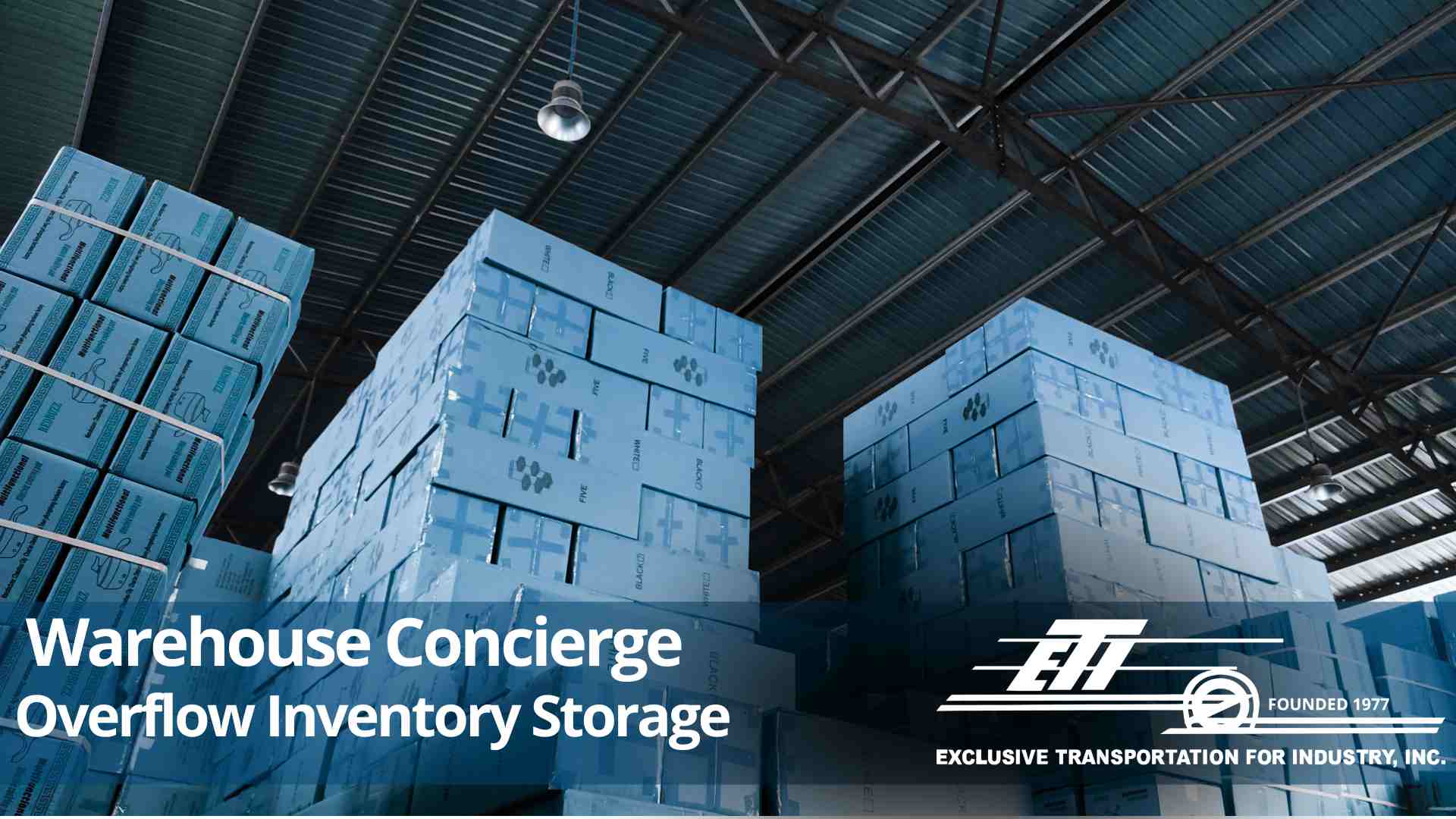
This is where freight planning becomes less about perfect forecasting and more about building a flexible buffer close to the plant. ETI supports that buffer with short term warehousing and cross dock solutions in Allentown, backed by real time visibility and time critical execution. You may also hear this model referenced as ETI’s Warehouse Concierge service.
Why tariffs create freight stop and start cycles
Tariff changes rarely affect freight in a smooth, gradual way. They tend to trigger bursts and pauses.
- Pull forward inventory: Shippers accelerate inbound moves to get ahead of potential increases.
- Supplier switches: Procurement adjusts sourcing, which creates new lanes, new lead times, and more exceptions.
- Split orders and partials: To manage landed cost and availability, shipments arrive in smaller batches across more carriers.
- Portfolio reshuffles: Companies re prioritize what they bring in now versus later, which changes volume patterns at the plant.
The operational result is not just more freight or less freight. It is uneven freight. That unevenness is what breaks receiving schedules.
What volatility looks like inside a manufacturing operation
When tariff uncertainty hits, the pain points are practical and immediate.
- Dock congestion: Too many trucks, not enough doors, and no room to stage safely.
- Scheduling pressure: Missed appointment windows create a chain reaction of delays, detention, and rework.
- Inventory friction: Materials show up before there is a place to put them, or after production needed them.
- Exception events: The plan changes mid week, and teams spend time reacting instead of executing.
This is why the most resilient operations build flexibility close to their plants and customers. They do not rely on the network to behave perfectly. They create a controlled midpoint that turns uncertainty into a schedule.
The resilience playbook: build a flex buffer close to the plant
A flex buffer is not necessarily a long term warehousing decision. In many cases, it is a short term operating strategy that gives the plant back control.
There are three levers that matter most.
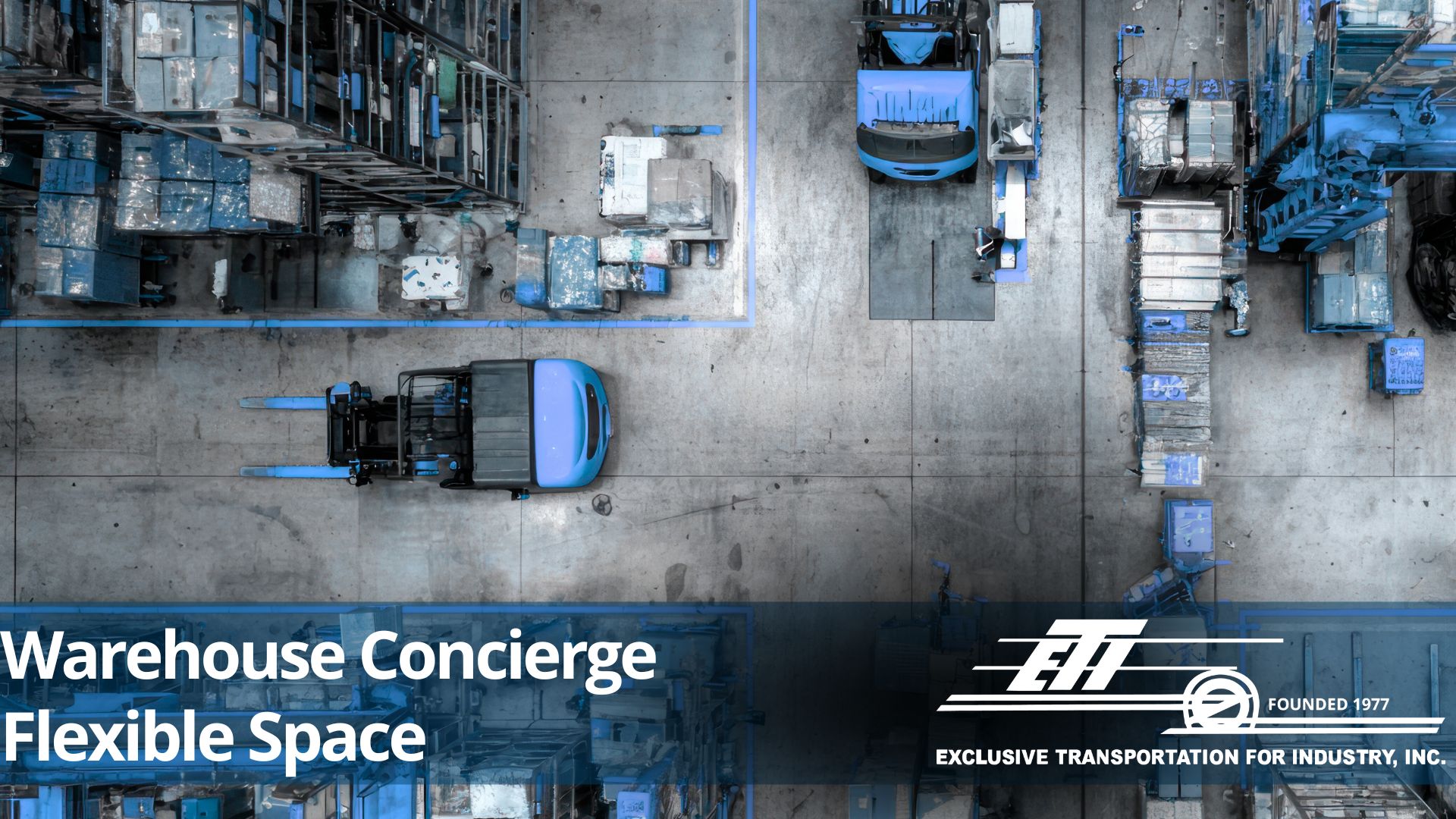
1) Controlled staging to protect the dock schedule
If inbound timing becomes unpredictable, the plant needs a way to receive freight without flooding the dock and the floor.
Short term staging creates breathing room. Freight can be received off site, staged briefly, and released to the plant in planned waves that match dock capacity and production priorities.
ETI’s Allentown operation is built to support this type of surge response through cross dock and short term staging services when inbound volumes spike or receiving windows get tight.
2) Visibility that stays intact when plans change
During volatility, the real cost often comes from time spent chasing information.
If a load is running late, arriving early, or being redirected, the plant needs clarity fast. Where is it right now. What is the ETA. What documentation is available. Who has the next handoff.
ETI supports this with Crown Connect shipment tracking and documentation, a visibility and documentation portal designed to keep customers informed and organized. When freight planning shifts, visibility becomes a control tool, not a nice to have.
3) Fast exception response when the network gets messy
Volatility creates more exceptions. More reschedules. More urgent parts. More changes to the inbound plan.
ETI’s operating model is built around time sensitive execution, supported by GPS tracking and alerting so issues can be surfaced quickly and managed before they cascade into bigger disruptions. This security minded approach is reinforced in ETI’s resource on cargo theft prevention in the Northeast and Mid Atlantic.
How tariff volatility increases dock bottlenecks
Here is the hidden connection between tariffs and dock congestion.
When shippers pull freight forward, volume spikes tend to arrive in tight windows. When suppliers change, timing becomes less predictable. When orders split into smaller shipments, the number of inbound appointments increases even if total volume stays similar.
That means more arrivals to coordinate, more touchpoints, and more opportunity for delays.
A dock bottleneck is not only a space problem. It is a sequencing problem. A controlled staging point solves sequencing.
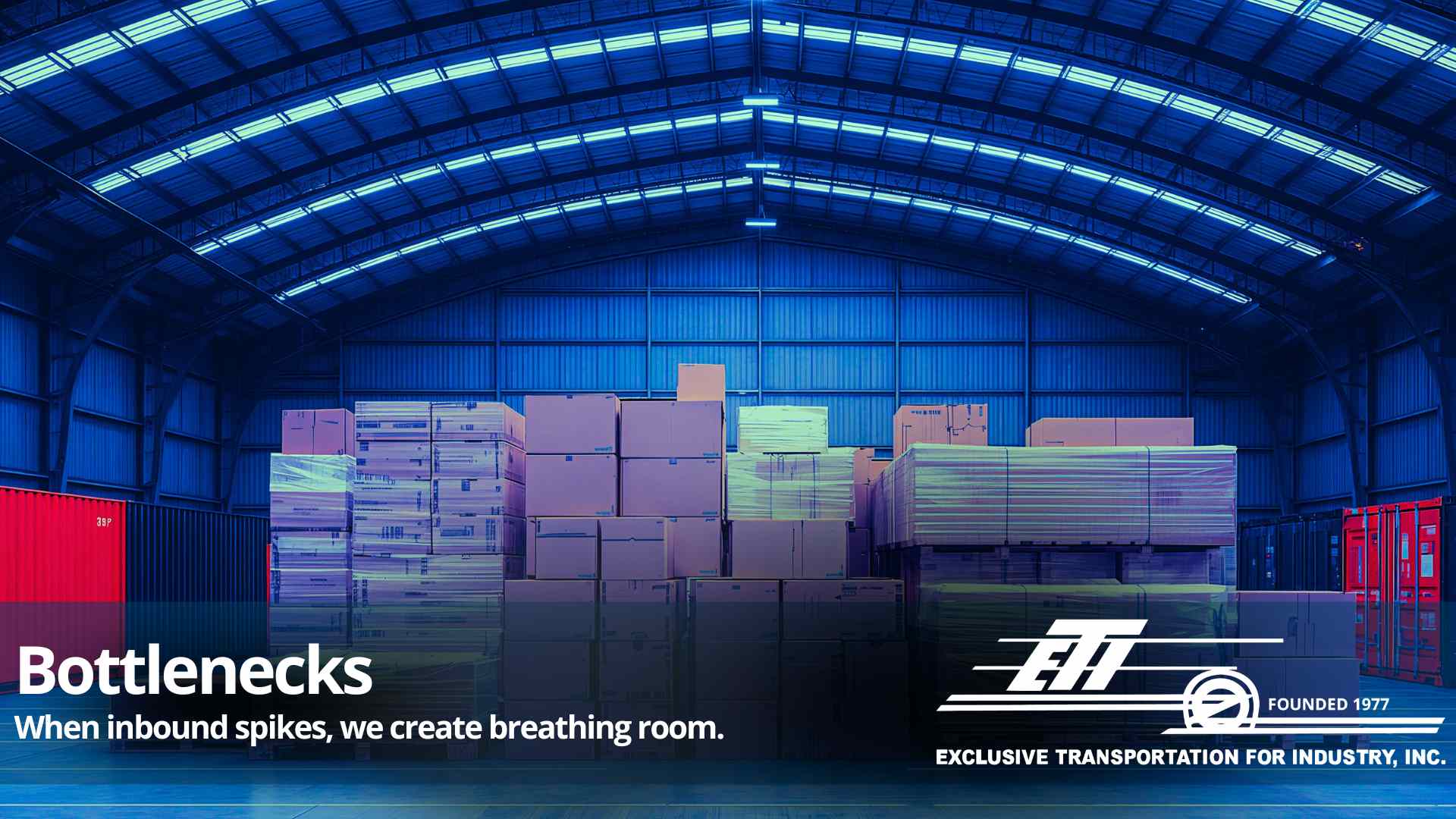
Where cross dock and short term staging fit into tariff era freight planning.
Cross dock and short term staging are often grouped together, but they solve slightly different problems.
- Cross dock is best when freight needs to move through quickly, often with consolidation, sorting, or rapid transfer to outbound equipment.
Short term staging is best when the plant needs a buffer for a few days or weeks to smooth out a surge, a project, or a timing mismatch. - In a tariff volatility environment, many manufacturers use both approaches at different moments in the same quarter.
The goal is not to add complexity. The goal is to protect production by creating a controlled release schedule, which is the heart of ETI’s Allentown cross dock and short term warehouse solutions.
Temperature controlled freight: volatility does not lower the stakes
Tariff driven shifts can affect sensitive freight, too. When a supplier changes or inbound timing compresses, temperature controlled shipments still need the same discipline and monitoring as always.
ETI operates temperature controlled assets for life sciences and other sensitive loads, supported by real time monitoring and visibility. ETI’s fleet capabilities include Thermo King refrigerated units, and their approach to handling high stakes shipments is outlined in temperature controlled life sciences shipping. For shippers preparing for expanded cold storage support, ETI has also shared updates related to pharmaceutical cold storage in Allentown.
Efficiency and sustainability are becoming part of resilience
Resilience is usually framed as speed and capacity. More manufacturers are also being asked to report on sustainability and emissions tied to logistics decisions.
Tariff volatility can push shippers into inefficient patterns like expedited moves, split shipments, and extra handling. The resilience opportunity is to respond in a way that restores control and reduces waste through smarter sequencing, fewer unnecessary miles, and fewer last minute moves caused by preventable dock bottlenecks.
ETI has shared its perspective on the industry’s path forward in navigating the impact of new federal emissions standards, emphasizing responsible progress that remains realistic for the freight environment.
A simple freight planning checklist for tariff uncertainty
Use this checklist when your team sees the early signs of a tariff driven surge, supplier shift, or sudden demand swing.
Before the surge hits
- Identify which inbound materials are most likely to be pulled forward.
- Confirm how many inbound appointments your dock can handle per day without creating safety or staging issues.
- Pre plan a controlled staging option for overflow freight so the plant does not become the buffer.
- Define who owns exception decisions when an inbound load misses a slot.
When inbound timing compresses
- Sequence deliveries based on production priority, not arrival order.
- Increase visibility touchpoints so the plant can plan labor and dock time with fewer surprises.
- Reduce handoff confusion by keeping documentation and status updates centralized, using tools like Crown Connect.
After the surge
- Review what created the bottleneck: appointment capacity, floor space, supplier timing, or communication gaps.
- Adjust your playbook for the next cycle, because volatility tends to repeat.
Frequently asked questions
How do tariffs affect freight planning?
Tariffs can trigger pull forward inventory moves, supplier changes, and lane shifts. Those changes often create uneven inbound volume, tighter appointment windows, and more exceptions that disrupt dock schedules and production timing.
What is inventory pull forward?
Inventory pull forward is when a company accelerates purchasing and inbound shipments to get ahead of potential tariff increases or policy changes. It can reduce landed cost risk, but it often creates short term congestion at docks and warehouses.
Why does tariff volatility cause dock congestion?
Because volume tends to arrive in compressed windows and shipment profiles often change. More partial shipments and supplier variability increase the number of inbound appointments, even when total volume stays similar.
What is the best way to reduce dock congestion during a volume spike?
The most reliable approach is to create a controlled buffer close to the plant. Short term staging and cross dock options allow freight to be received and then released on a schedule that matches dock capacity and production priorities.
What should we track during tariff driven schedule changes?
At minimum: real time shipment status, ETAs, exceptions, and documentation readiness. Centralized visibility reduces time spent chasing answers across multiple carriers and handoffs. Many shippers choose a single portal approach, such as Crown Connect shipment tracking and documentation, to keep updates and paperwork organized.
How does temperature controlled freight planning change during volatility?
The stakes stay high, but the need for control increases. If inbound timing compresses or suppliers shift, monitoring, disciplined handling, and reliable equipment matter even more. For sensitive freight, a planned staging and delivery sequence can reduce risk created by chaos at the dock. ETI’s approach is detailed in temperature controlled life sciences shipping.
Related ETI resources
- Short term warehousing and cross dock solutions in Allentown
- Crown Connect shipment tracking and documentation
- Temperature controlled life sciences shipping
- ETI perspective on emissions standards and sustainability
Closing thought
Tariff volatility is reshaping freight planning because it turns steady inbound flows into stop and start cycles. The manufacturers that win through these cycles are the ones that build flexibility close to their plants and customers.
A controlled buffer, supported by real time visibility and time critical execution, helps turn uncertainty into a schedule. That is how you protect dock capacity, protect floor space, and protect production, even when the freight rhythm changes without warning.
ETI Trucking
2202 26th St SW, Allentown, PA 18103
Service area: PA, NY, NJ, MD, CT, NH, ME